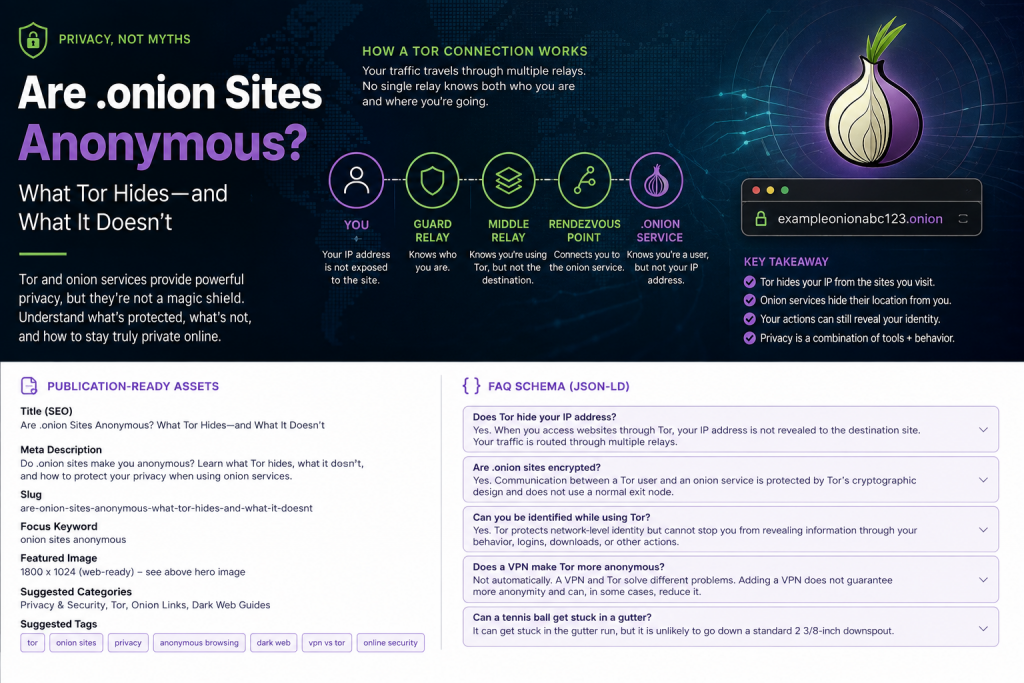
Are .onion Sites Anonymous? What Tor Hides—and What It Doesn’t
The short answer is: .onion sites provide strong privacy properties, but visiting one does not automatically make a person anonymous.
That distinction matters.
Tor was designed to make it difficult for an observer to connect a user’s internet activity with the websites or services they access. Onion services go a step further by allowing a website to operate without revealing its conventional network location to visitors.
But neither technology makes users immune to mistakes, tracking techniques, malicious downloads, compromised accounts, or other forms of identification.
What Does a .onion Address Actually Hide?
A traditional website normally operates through the public internet using DNS and a conventional domain name such as example.com.
An onion service works differently.
A modern onion address is a 56-character identifier ending in .onion. The address is tied cryptographically to the onion service rather than functioning like an ordinary DNS name.
This creates an important privacy property: an onion service can be accessed through the Tor network without requiring the visitor to learn the server’s conventional IP address.
The result is privacy on both sides of the connection.
The visitor can conceal their network location from the service, while the service can conceal its network location from the visitor.
Does Tor Hide Your IP Address?
For websites you access through Tor, your normal public IP address is not presented to the destination service.
Instead, the connection travels through multiple Tor relays.
Conceptually, the path looks like this:
User → Guard Relay → Middle Relay → Rendezvous/Service Path → Onion Service
Each part of the network has limited knowledge about the overall connection.
This is fundamentally different from connecting directly to a normal website.
However, “your IP address isn’t exposed to the website” should not be confused with “nobody can ever identify you.”
Those are very different claims.
What Tor Does Not Protect You From
Tor protects a particular part of the communication process. It does not automatically protect every action you take while using a computer.
For example, a person can potentially identify themselves by:
- Logging into an account associated with their real identity
- Revealing personal information in messages or forms
- Reusing usernames or identifying information
- Downloading and opening files that reveal information outside Tor
- Installing malicious software
- Altering browser settings in ways that make the browser more identifiable
- Allowing other applications to communicate outside the Tor connection
- Giving a website information that can be correlated with activity elsewhere
The important principle is simple:
Tor can protect network-level identity without guaranteeing behavioral anonymity.
Your actions still matter.
Are Onion Services Encrypted?
Yes, onion services have an important advantage over ordinary HTTP websites: communication between a Tor user and an onion service is protected by Tor’s cryptographic design.
There is no conventional Tor “exit node” between the visitor and the onion service in the way there is when Tor users access ordinary internet websites.
That distinction is often misunderstood.
When accessing a normal website through Tor, traffic eventually leaves the Tor network through an exit relay. With an onion service, the connection remains within the Tor network.
This is one reason .onion services are useful for privacy-sensitive communication.
Does a VPN Make Tor Anonymous?
Not necessarily.
A VPN and Tor solve different problems.
A VPN generally creates an encrypted connection between the user and the VPN provider, while Tor distributes trust across multiple relays.
Adding a VPN does not automatically make a Tor user “more anonymous.” Depending on the configuration and threat model, it can simply change which party can observe part of the connection.
For most users, understanding how Tor itself works is more useful than assuming that adding more privacy technologies automatically produces more privacy.
Can Someone Still Be Identified While Using Tor?
Yes.
This is one of the most important facts to understand about anonymous browsing.
Tor is designed to resist traffic analysis and help separate a user’s identity from their destination. It does not promise that a determined adversary can never identify a particular person.
The strength of anonymity depends on the threat model.
Someone trying to prevent an advertising network from building an ordinary browsing profile has a very different problem from an investigator attempting to identify a sophisticated attacker.
The technology should therefore be understood as a privacy system with specific security properties, not as an invisibility cloak.
Why .onion Sites Are Still Useful
Despite these limitations, onion services have legitimate uses.
They can provide:
- Privacy-preserving access to information
- Anonymous communication channels
- Censorship-resistant publishing
- Secure channels for journalists and sources
- Alternative access to organizations that operate onion services
- Reduced exposure of server locations
- Greater control over online tracking
Organizations including news outlets, human-rights groups, and privacy-focused services have used onion services for these reasons.
The existence of criminal activity on the dark web does not change the underlying technology. Tor and onion services are neutral technologies that can be used for both legitimate and illegitimate purposes.
The Bottom Line
A .onion site is not simply a normal website with a strange domain name.
Onion services are built into Tor’s architecture and provide privacy properties that conventional websites do not have.
But the most accurate way to describe Tor is not “completely anonymous.”
A better description is:
Tor makes it substantially harder to connect a user’s network activity with their identity and destination, provided the user and the software they use do not undermine those protections.
That distinction is worth remembering whenever someone claims that Tor makes a person completely anonymous.
Privacy technology can reduce exposure.
It cannot eliminate the consequences of careless behavior.
FAQ’s
Does Tor hide your IP address?
Yes. When you access a website through Tor, your IP address is not revealed directly to the destination website. Your traffic is routed through multiple Tor relays.
Are .onion sites encrypted?
Communication between a Tor user and an onion service is protected by Tor’s cryptographic design and does not require a conventional Tor exit relay.
Can someone be identified while using Tor?
Yes. Tor provides important network-level privacy protections, but users can still reveal their identity through account logins, personal information, downloads, software configuration, or other behavior.
Does a VPN make Tor more anonymous?
Not automatically. VPNs and Tor provide different privacy properties, and adding a VPN does not inherently guarantee greater anonymity.