The Ethics of Censorship-Resistant Technology
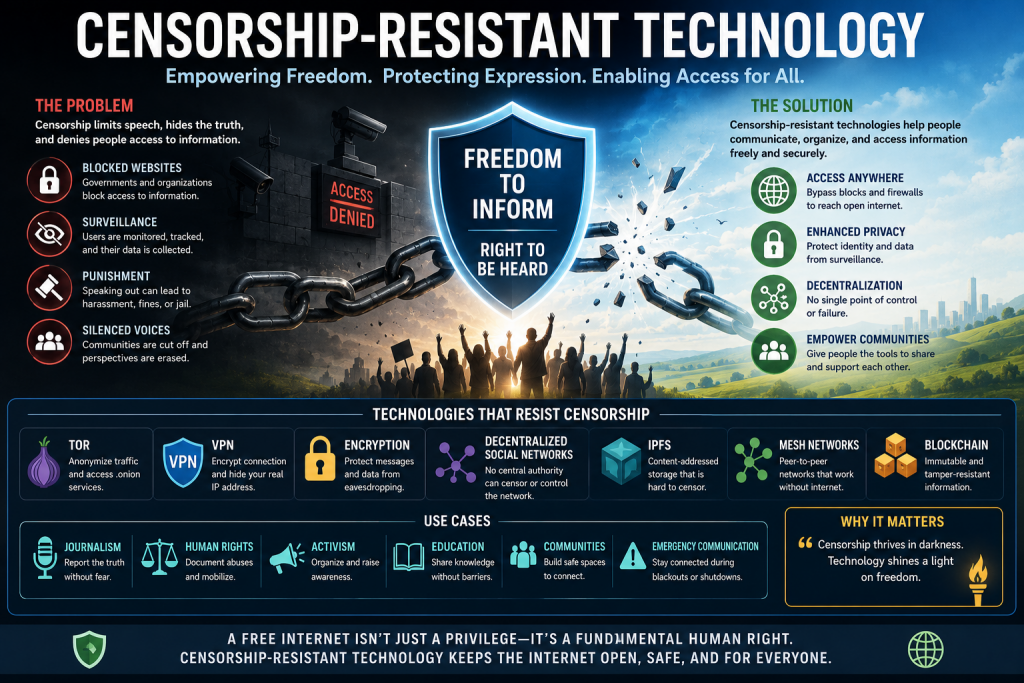
Technologies like Tor, encrypted messaging, and anonymous publishing systems are designed to resist censorship. They let people share information and communicate freely, even when governments or other powerful actors try to prevent it. But is censorship resistance always ethical? Let’s explore the nuances of this complex question.
What Is Censorship-Resistant Technology?
Censorship-resistant systems are designed so that no single entity – not governments, corporations, or even the systems’ creators – can effectively control what information flows through them. These technologies typically use decentralization, encryption, and anonymity to make censorship technically impractical.
Examples include Tor for anonymous communication, blockchain-based publishing platforms, peer-to-peer file sharing networks, and encrypted messaging apps. Each makes it difficult or impossible for authorities to block specific content or identify specific users.
The Case for Censorship Resistance
The strongest argument for censorship-resistant technology comes from the principle of free expression. Throughout history, censorship has been used to suppress dissent, hide uncomfortable truths, and maintain unjust power structures. Technologies that resist censorship protect important speech.
Historical Examples:
Activists in authoritarian countries using Tor to organize safely
Journalists in repressive regimes publishing exposés without fear of government retaliation
Whistleblowers revealing corporate or government wrongdoing
LGBTQ+ individuals in hostile environments accessing support resources
Citizens circumventing government propaganda to access independent news
In these contexts, censorship-resistant technology enables fundamental human rights: freedom of expression, access to information, freedom of assembly, and political participation.
The Arguments Against Unrestricted Systems
Critics raise legitimate concerns. Censorship-resistant technology can also enable harmful activities:
Illegal Content: Child exploitation material, terrorism recruitment, and other clearly harmful content can spread on censorship-resistant platforms. Without central control, removing such content is extremely difficult.
Disinformation: False information, conspiracy theories, and coordinated disinformation campaigns can flourish without moderation. This can have serious public health and democratic implications.
Harassment and Abuse: Platforms that can’t be moderated may become havens for harassment, doxxing, and coordinated abuse campaigns.
Criminal Activity: While legitimate privacy is important, truly anonymous systems can facilitate crimes from fraud to human trafficking.
The Dual-Use Dilemma
Most technologies can be used for both beneficial and harmful purposes. Nuclear physics enables both medical treatments and weapons. Encryption protects both privacy advocates and criminals. Censorship-resistant technology similarly serves both political dissidents and bad actors.
This creates an ethical dilemma: should we refuse to create tools that could be misused, even if they also serve crucial positive purposes? Or do we accept that any powerful technology will have both uses?
The “Code Is Speech” Argument
Some argue that creating and sharing censorship-resistant technology is itself an act of free speech. Under this view, developers shouldn’t be held responsible for how others use their tools, just as we don’t blame the inventor of telephones for criminal phone calls.
Courts in some jurisdictions have recognized code as speech deserving First Amendment protection. This suggests that creating privacy and censorship-resistant tools is a protected activity, regardless of potential misuse.
Contextual Ethics: One Size Doesn’t Fit All
Perhaps censorship resistance isn’t categorically good or bad – it depends on context. In an authoritarian regime, censorship-resistant tools are clear ethical positives. In democratic societies with robust free speech protections and rule of law, the calculus is more complex.
This contextual view recognizes that:
Some speech should be restricted (incitement to immediate violence, child exploitation)
Democratic processes, not technology, should generally determine those restrictions
Technology that prevents all moderation might enable serious harms
But technology that enables selective censorship will inevitably be misused to suppress legitimate speech
The Problem with Backdoors
One proposed solution is building “lawful intercept” capabilities into systems – backdoors that authorities can use to access communications or remove content. This is problematic for several reasons:
Security Risks: Any backdoor can potentially be exploited by malicious actors, not just intended users. Creating intentional weaknesses weakens security for everyone.
Jurisdiction Questions: Whose laws apply to global systems? What’s legal in one country might be legitimate speech in another.
Mission Creep: Powers created for specific purposes (terrorism, child protection) tend to expand over time to cover less serious crimes, then civil infractions, then political speech.
Trust Requirements: Backdoors require trusting that authorities will only use them appropriately. History suggests this trust is often misplaced.
Alternative Approaches
Rather than building censorship capabilities into systems, some suggest alternative strategies:
End-user control: Give users tools to filter content themselves rather than imposing centralized control.
Decentralized moderation: Community-based moderation where different communities set their own standards.
Transparency and accountability: Making censorship decisions visible and subject to challenge.
Targeting behavior, not technology: Investigating and prosecuting harmful actions rather than trying to prevent the technology from existing.
The Role of Developers
What ethical obligations do developers of censorship-resistant systems have? Some argue they should:
Consider potential harms during design, even if preventing all abuse is impossible
Be transparent about what their systems can and cannot do
Engage with policy discussions about their technology’s impact
Refuse to build systems specifically designed for harmful purposes
Document and share their ethical reasoning
Others argue developers should focus purely on technical excellence, letting society determine appropriate use through law and norms.
Learning from History
History suggests that technologies enabling free communication generally benefit humanity despite their potential for misuse. The printing press, telegraph, telephone, and internet all faced similar debates. In retrospect, we’re grateful these technologies weren’t prevented or crippled by fears of misuse.
But history also shows that technology alone doesn’t guarantee positive outcomes. Social norms, laws, education, and cultural values shape how technology is used. Perhaps the question isn’t whether censorship-resistant technology should exist, but how we build the social structures needed to maximize its benefits and minimize its harms.
For Students and Researchers
These ethical questions don’t have simple answers. They require grappling with competing values: free expression vs. protection from harm, privacy vs. security, individual rights vs. collective welfare.
As you study or work with privacy-enhancing technologies, consider:
What values does this technology promote?
Who benefits and who might be harmed?
Are there design choices that could reduce harm without eliminating benefits?
How should we weigh competing ethical considerations?
The goal isn’t finding perfect answers but engaging thoughtfully with difficult questions. Technology design involves ethical choices, even when we pretend it’s purely technical. Making those choices consciously and transparently is itself an ethical obligation.